
We would never expect an elite athlete to attend one preseason clinic and then compete all year. Yet that’s exactly how many organizations treat leadership development.
In sports, training dominates the calendar. In corporate life, “game day” dominates. Leaders are coaching, deciding, presenting, hiring, firing, aligning, and navigating ambiguity all while the scoreboard is running. There is no quiet preseason. There is no off-field reset. The pressure is constant.
And still, many times organizations rely on a “one and done” approach to leadership development and hope it sticks.
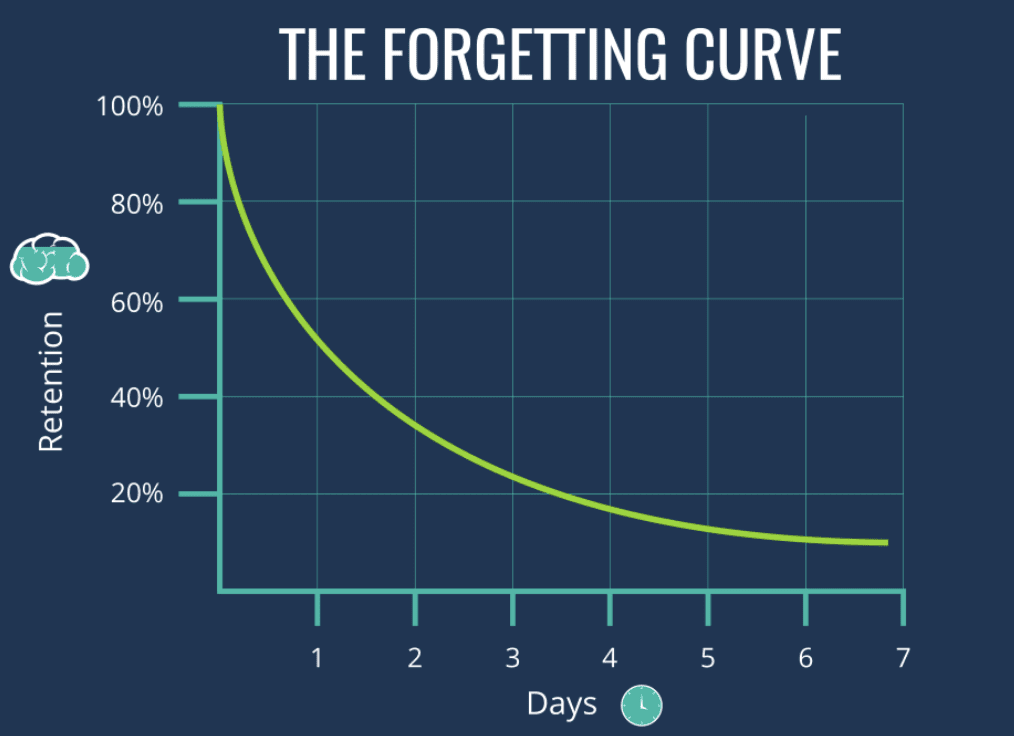
Research has shown it doesn’t work. The forgetting curve by founded by Hermann Ebbinghaus, a German psychologist, has made that clear for decades: without reinforcement, most of what we learn in a single event fades within days. Not because people aren’t capable but because the brain wasn’t designed to retain unused insight under pressure.
If corporate life is game day every day, then development cannot be episodic. It has to be embedded.
Skills Become Reflexes Through Repetition
Cognitive science gives us a better blueprint. The spacing effect shows that learning revisited and applied over time moves into long-term memory. Repetition under real conditions wires capability into reflex.
Athletes run drills between games so performance holds under pressure.
Leaders need the same. Monthly learning sprints. Coaching conversations. Structured reflection. Practice labs after workshops. Follow-ups that require application, not attendance.
Without repetition, leaders default to habit. With repetition, leaders build agility.
That difference shows up exactly when it matters most.
The Most Strategic Work Rarely Feels Urgent
This is where Stephen Covey’s Time Management Matrix becomes more than a productivity tool it becomes a leadership lens.
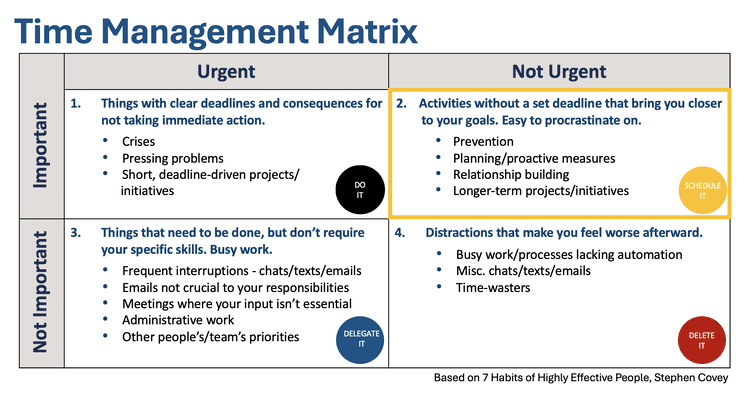
Quadrant 2 “important and not urgent” is where development lives. Coaching. Reflection. Capability building. Relationship investment. Systems thinking.
When leaders live exclusively in Quadrant 1 “important and urgent” they stay reactive. When they protect Quadrant 2, they build judgment before the crisis hits.
And here’s what makes this even more powerful: neuroscience supports it.
When we step out of constant firefighting, during a walk, a workout, or even a quiet commute, the brain’s default mode network activates. That’s when insight connects. Patterns emerge. Strategy sharpens.
The clarity we need under pressure is often built in moments without it. Quadrant 2 isn’t time away from performance. It’s where performance is constructed.
Stop Treating Development Like an Event
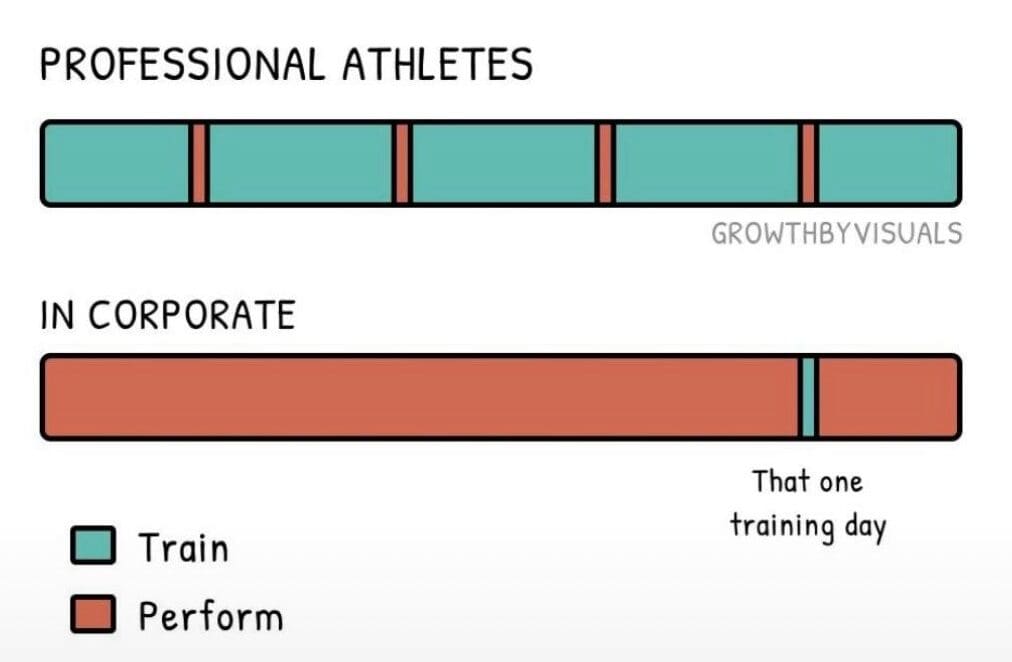
The athlete comparison works because it exposes a structural flaw:
- Professional athletes spend most of their time training so they’re ready for game day.
- Corporate leaders spend most of their time in game day and almost none in training.
We’ve inverted the ratio.
If we want leaders who can think clearly in ambiguity, coach effectively in conflict, and make sound decisions under pressure, development must become ongoing, spaced, and protected.
Not an annual workshop. Not a motivational moment. Not a checkbox. A system.
When organizations deliberately move time and attention into Quadrant 2 and use that space for repeated learning, application, and reflection, development stops being a “nice to have.” It becomes the engine of sustained performance.
Because in a world where it’s always game day, the only competitive advantage is how you train between plays.
